

Why Every Independent Musician Needs a Website
You've got tracks on Spotify, a decent Instagram following, and maybe a few hundred YouTube views. For most, it is satisfying enough to share their creativity with the world, but you may not really think about how a lot of musicians are essentially a small business.
This naturally leads people to a lot of questions. Do I need an LLC? Who owns my music? How do I continue to market in such a crowded environment? Although the answer is not as straightforward as some businesses, you should still consider them and give new things a chance despite the fast-paced nature of owning a band.
The Problem With Social Media
Social platforms aren't built for you. Accounts get hacked, banned, or simply deleted. When that happens, everything you built on that platform disappears with it. You'll miss fans who dropped a like one time or gave you a follow, but never listened to your music beyond a quick post.
I have often seen some artists link to their Linktree or other similar link-in-bio tools, which as the name implies, are simply tools in a larger scheme. Your home base cannot be a place which branches off into other distracting elements. Like with your music, you need creative control beyond this.
A website gives you full control. You choose the design, the content, the experience. Nobody can take it from you or bury it in a feed.
Some artists take this very lightly and make a landing page, some add details and documents nobody has seen before. Both ways are fine, as long as you have a place for fans to learn more about who you are.
Most bigger bands will have Spotify, social media, merch and depending on the artist, a place for booking inquiries. This just isn't possible without a website in place for people to visit.
Building Real Credibility
When someone looks you up, interested in your band, and it's just a personal Instagram or a "scattered" Linktree, you've missed an opportunity of a lifetime. You can't hook people with a quick post or a clip of a song. First impressions can be the difference between getting booked or getting passed over.
Here's a simple truth: many independent musicians don't have a website. Just having one puts you ahead.
Fan Bases Await
Platforms come and go but something like a Shopify store can change regardless of what happens to Instagram or TikTok or whatever comes next. Your website is where that relationship starts. Forming a fan base is difficult when people pass by your content in a sea of more engaging things.
Most fans will also want to support you. You may already have a website, and it may even link directly to your store or Bandcamp, but a domain can do so much more than you think.
Tell Your Story Your Way
Every artist has an interesting story of why they started. In a past life on my own website, I wrote about my favorite album
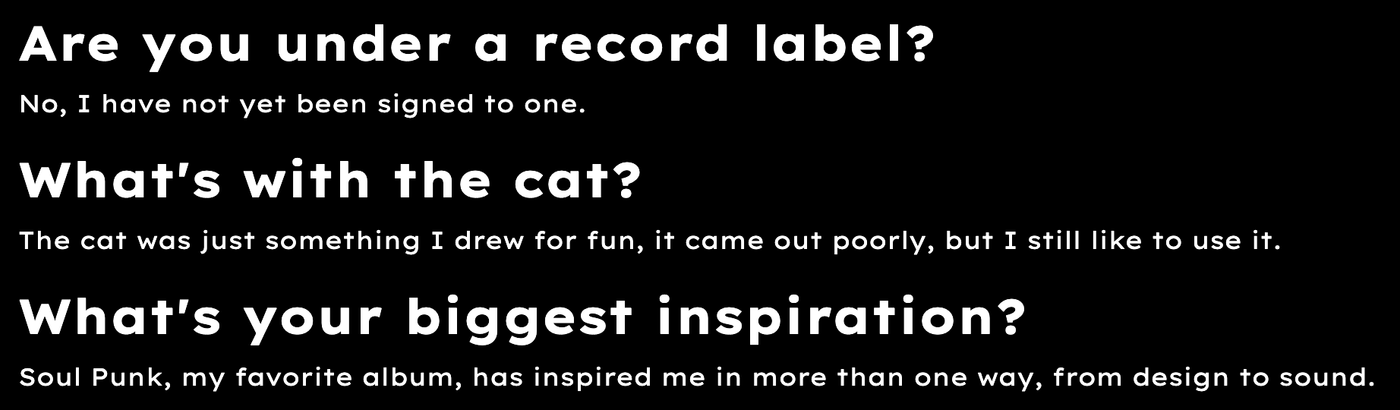
Even a simple FAQ felt personal, because it was personal. The potential for your website is infinite as an artist and evolves while you create your own unique stylized brand in your work.
Getting Found on Google
Social Profiles Don't Rank
As I discussed in my article about "Why Google Visibility Matters" when someone searches "[your name] musician" or "[your genre] artist in [your city]," social media profiles rarely show up near the top. Good SEO means people can discover your music without already knowing you exist.
Local Discovery is a Real Opportunity
Local SEO is especially powerful for independent musicians. Optimize your site with location-based language — "indie folk musician in Nashville" or "jazz guitarist available for events in Chicago" — and you can appear in front of local promoters and venue owners who are actively searching.
Tours Are Easy to Find
It always felt like, to me, that they printed tour dates on shirts because it was the only way for people to know what the actual dates were at times. You are going to be personally busy and with no one else around to help, you may forget to properly notify everyone. Maybe you hired a designer, who made you a tour poster. You can't rely on Instagram stories to give people directions.
Selling Directly to Fans
Streaming pays fractions of a cent per play. When fans buy directly through your website, most of that money stays with you. Of course, for tax benefits, Bandcamp is great, but, if you have a website, you are not missing out on the benefits of a marketplace like Bandcamp. It's just one way to sell your music.
Attract Collaborators or Press
Venues, collaborations and so much happen because a band is able to get their songs in front of people and in their ears. You don't want to get lost in a sea of results. If people look you up, they want to see you and not people like you.
Understand With Real Data
If people from a specific city keep visiting your tour dates page, that's worth knowing. It's super valuable insights. If a behind-the-scenes blog post keeps pulling traffic, you know what resonates.
Which cities should you tour? What content should you make more of? Where should your promotional energy go? Your website can answer all of it. It's the reason LiveJournal or MySpace were so popular.
They were essentially walls of text, a feed of only you/your band and anyone could talk about their tour, write poems, or do whatever. It was social media but the pages were so customized, people felt personal connections with the designs or genres that spoke to them. Fans just wanted to hear from them and learn about their favorite music.
How to Get Started
Website builders are more than capable of the job. However, some bands hire agencies. For example, The Smashing Pumpkins hired RecCenter. Their website is surprisingly full of details and contains archives of their songwriting processes. This can be complicated so don't be afraid to hire someone to help.
Your Career Is Worth It
In a music industry that's more competitive and more digital than ever, a website isn't optional for independent musicians. It's where your brand lives, where fans become subscribers, where venues book you, and where you earn income on your terms.
Social media is a great tool for discovery. But it works best when it points people toward something you actually own and there are many creative examples as to why you should make a website.